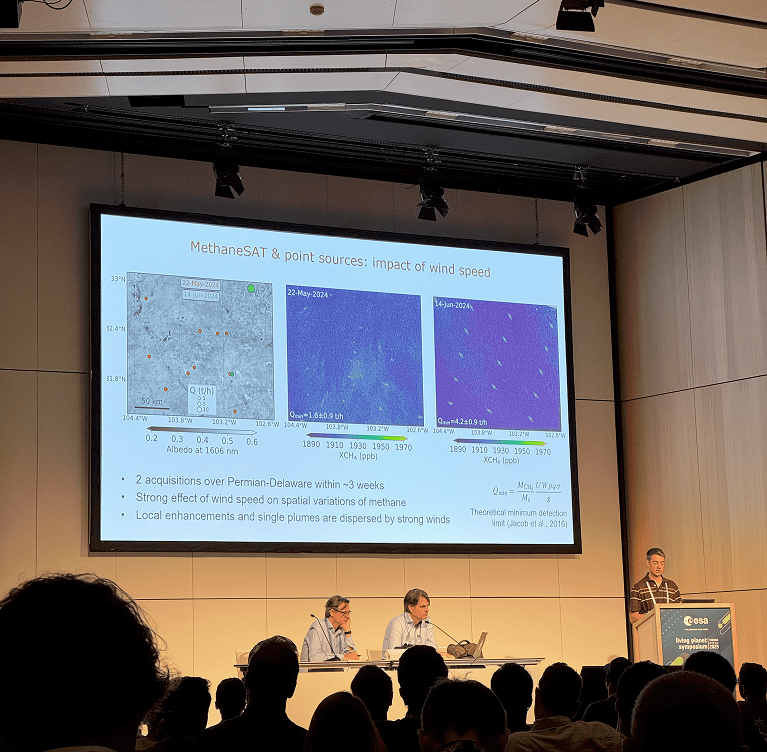
Over the past few months, monitoring greenhouse gases (GHG) using remote sensing data has become one of my primary areas of interest. This direction was strongly reinforced by my recent participation at the Living Planet Symposium 2025 (#LPS25) in Vienna, organized by the European Space Agency.
The event brought together the global Earth Observation community, and it left me inspired—not just by the groundbreaking research and tools on display, but also by the passionate people behind them. From data providers to academic researchers and industry pioneers, I had the chance to meet and learn from experts who are at the forefront of GHG monitoring and emission estimation.
As part of my personal roadmap, I’m dedicating the next two years to developing an innovative solution that leverages Earth Observation for better GHG tracking, emission quantification, and potentially contributes to a new type of offsetting framework. I hope to share more about this ongoing work here on the blog soon…
Interestingly, just days after I started diving into MethaneSAT data, I came across breaking news that the satellite had unfortunately gone silent. First reported by The Guardian (link) and later confirmed by MethaneSAT itself (link) 😅
That said, the field is rich with alternative data sources: Sentinel-5P, GHGSAT, EnMAP, PRISMA, and others continue to deliver valuable insights. These will all play a role in shaping and training the object detection algorithms my team is working on for our future product.
I also came back from #LPS25 with a full library of materials, including key presentations and slides specifically focused on GHG monitoring from space. If you’re working in a related area or just curious, feel free to reach out—I’m always happy to share and discuss!
Leave a Reply